
The short version: The NBA restricted area and FIBA no-charge semi-circle both affect particular charge/block decisions near the basket, but neither settles every collision. Check the league, player path, catch location, airborne status, defender position, verticality, and illegal-contact exceptions before reaching a conclusion.
Key takeaways
- NBA and FIBA use related but distinct restricted-area frameworks.
- The NBA comments describe a 4-foot-radius arc for the stated charging purpose.
- NBA verticality depends on legal position, timing, and being airborne at contact in the cited example.
- FIBA requires specific airborne, shot-or-pass, and defender-foot-contact conditions.
- Baseline-side, rebound, and illegal-contact exceptions prevent a one-rule shortcut.
The short answer: the arc is not a universal answer to contact
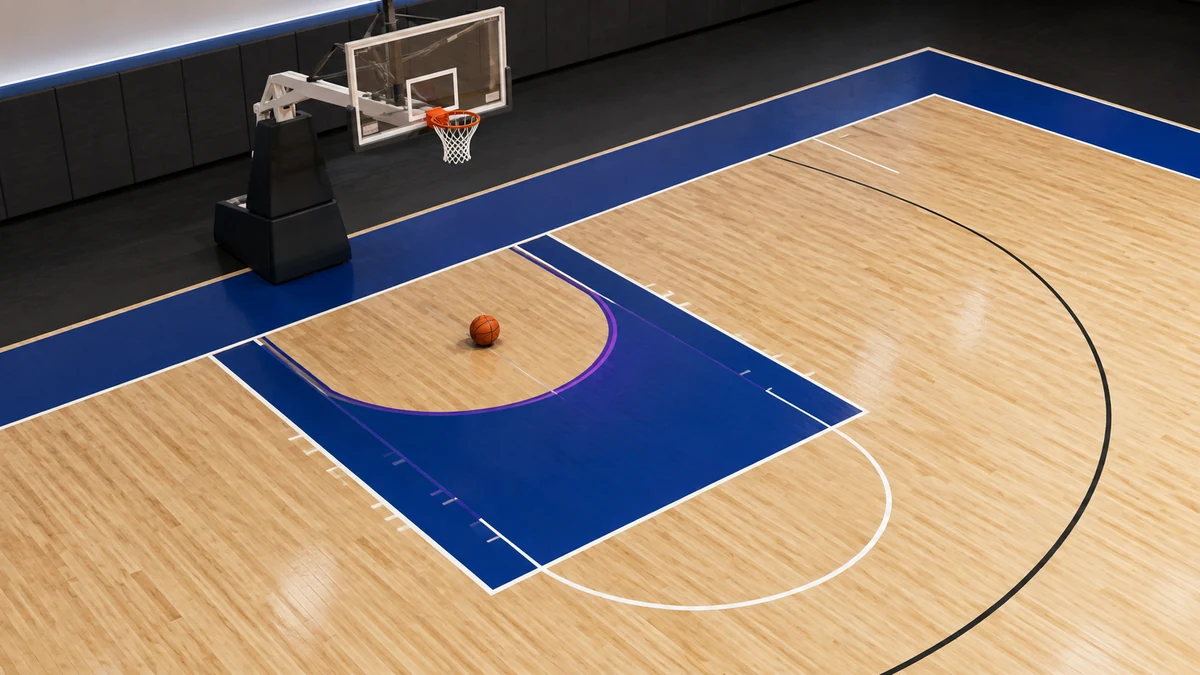
The restricted area does not turn every collision under the rim into the same call. It is a marked area used in a particular charge/block analysis, and the exact wording depends on the league. The NBA comments describe an arc with a 4-foot radius measured from the center of the basket ring for this purpose. FIBA calls its marking a no-charge semi-circle and says it is designated for interpreting charge/block situations under the basket. NBA Comments on the Rules FIBA Official Basketball Rules 2024
For players and coaches, the important habit is to identify the governing rulebook before arguing from a broadcast replay. NBA restricted-area guidance and FIBA no-charge-semi-circle guidance have related aims, but their conditions and exceptions are written differently. The arc is one part of the decision; it does not erase the need to evaluate the player’s path, timing, body use, and the relevant competition’s rules. FIBA Official Basketball Rules Interpretations 2024
What the NBA restricted-area guidance says
The NBA comments say an offensive foul for charging should not be called when contact is with a secondary defender established within the designated restricted area to draw an offensive foul, provided the offensive player takes a direct path to the rim. That statement is narrowly framed around the secondary defender and the specified path. It is not a shortcut for ignoring other illegal contact or every kind of play near the basket. blocking and charging fouls
The NBA comments also describe the lower defensive box as the area between the 3-foot posted-up marks, the bottom tip of the circle, and the endline. They list an exception allowing a player to be legally positioned within the restricted area when the offensive player receives the ball within that lower defensive box. This is why the origin of the catch can matter as much as where the contact finishes.
Verticality is another named NBA condition. The NBA Rule Authority explains that a secondary defender can avoid a blocking foul inside the restricted area by jumping vertically to defend the shot, but only after establishing legal guarding position before the offensive player’s upward motion. In its example, the defender must be in the air at contact; standing on the floor inside the area with arms up is assessed as a blocking foul. NBA Rule Authority: Restricted Area and Verticality Plays cylinder and verticality
What the FIBA no-charge semi-circle does
FIBA’s Official Basketball Rules say that, on a penetration play into the no-charge semi-circle, contact caused by an airborne offensive player with a defender inside the area is not called as a team-control foul unless the offensive player illegally uses hands, arms, legs, or body. The language describes a specific contact ruling; it does not give an airborne player permission to create illegal contact.
The FIBA conditions matter. The rule applies when the offensive player controls the ball while airborne and attempts a shot or a pass. The interpretations add that the defender must have one or both feet in contact with the semi-circle area, including its line, and that the offensive player drives over the semi-circle line to attempt a shot or pass while airborne. Read those conditions together rather than treating the paint as one undifferentiated zone.
FIBA explains the purpose in practical terms: the rule is intended not to reward a defender who takes a position under the basket to draw a charging foul against a ball-controller driving to the basket. That purpose is useful context, but the written criteria still control. A defender’s location, the driver’s route, airborne status, and any illegal body use remain relevant to the actual decision.
When the FIBA semi-circle criteria do not apply
FIBA’s interpretations say the no-charge-semi-circle criteria do not apply to plays outside the semi-circle or to plays developing from the area between the semi-circle and the endline. In those situations, contact is judged under the ordinary rules, such as the cylinder principle and charge/block principle. The practical lesson is not to draw an imaginary arc on film and stop the review there.
The interpretations also exclude rebounding situations after a shot when illegal contact occurs. A rebound is a new basketball event with its own positions, timing, and contact. Do not carry a penetration-play conclusion forward simply because players are still near the same basket after the ball hits the rim.
Finally, FIBA says the semi-circle criteria do not apply to illegal use of hands, arms, legs, or body by either player. That exception is particularly important for teaching: the marking does not excuse a push, arm bar, leg extension, or other illegal body action. The right review sequence is location, play type, required criteria, and then the actual contact.
How to review a play without guessing
Pause a clip before contact and identify the competition. If it is an NBA rules question, ask whether the defender is secondary, whether the offensive player has a direct path to the rim, whether the catch occurred inside the lower defensive box, and whether an asserted verticality exception meets its timing requirement. If it is a FIBA question, identify the semi-circle, the offensive player’s airborne ball control, the shot-or-pass attempt, and the defender’s foot contact with the area.
Then ask what the contact itself shows. Under FIBA, the semi-circle criteria do not apply when either player illegally uses hands, arms, legs, or body, and they do not apply to the stated rebound or baseline-side situations. This keeps a team from teaching an oversimplified message such as “inside the arc means no charge.” Basketball decisions stay more accurate when the rule conditions are checked in their written order. basketball workout library
For practice, use a low-speed drive-and-contest drill. Stop each rep before the last step and have players state the rule set, the defender’s location, and the available legal choice. This is not an officiating certification exercise; it is a way to build safer, more deliberate decisions around the rim while acknowledging that officials apply the live play under the governing competition rules.
Frequently asked questions
Does the restricted area mean the defender is always late?
No. In the NBA Rule Authority example, a secondary defender inside the restricted area can avoid a blocking foul by establishing legal guarding position before the offensive player’s upward motion and then jumping vertically to defend the shot. The defender must be in the air at contact in that example.
Does the FIBA semi-circle excuse an offensive player’s illegal contact?
No. FIBA’s rule says the stated team-control-foul protection does not apply when the offensive player illegally uses hands, arms, legs, or body. Its interpretations also say the criteria do not apply to illegal body use by either player.
Does the FIBA semi-circle rule apply on every play under the basket?
No. FIBA’s interpretations specifically exclude plays outside the semi-circle, plays developing from the space between it and the endline, and stated rebounding situations after a shot when illegal contact occurs. Those plays are judged under the applicable ordinary contact rules.