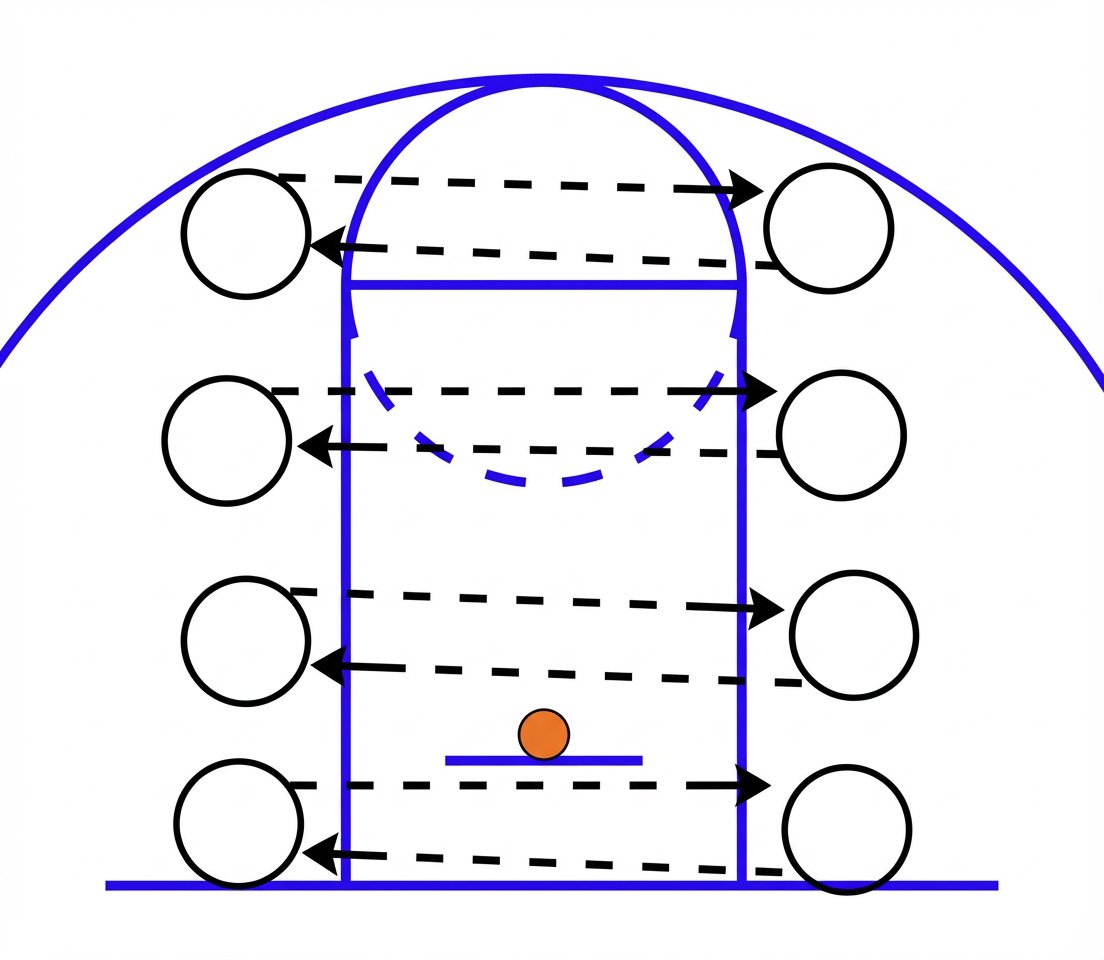
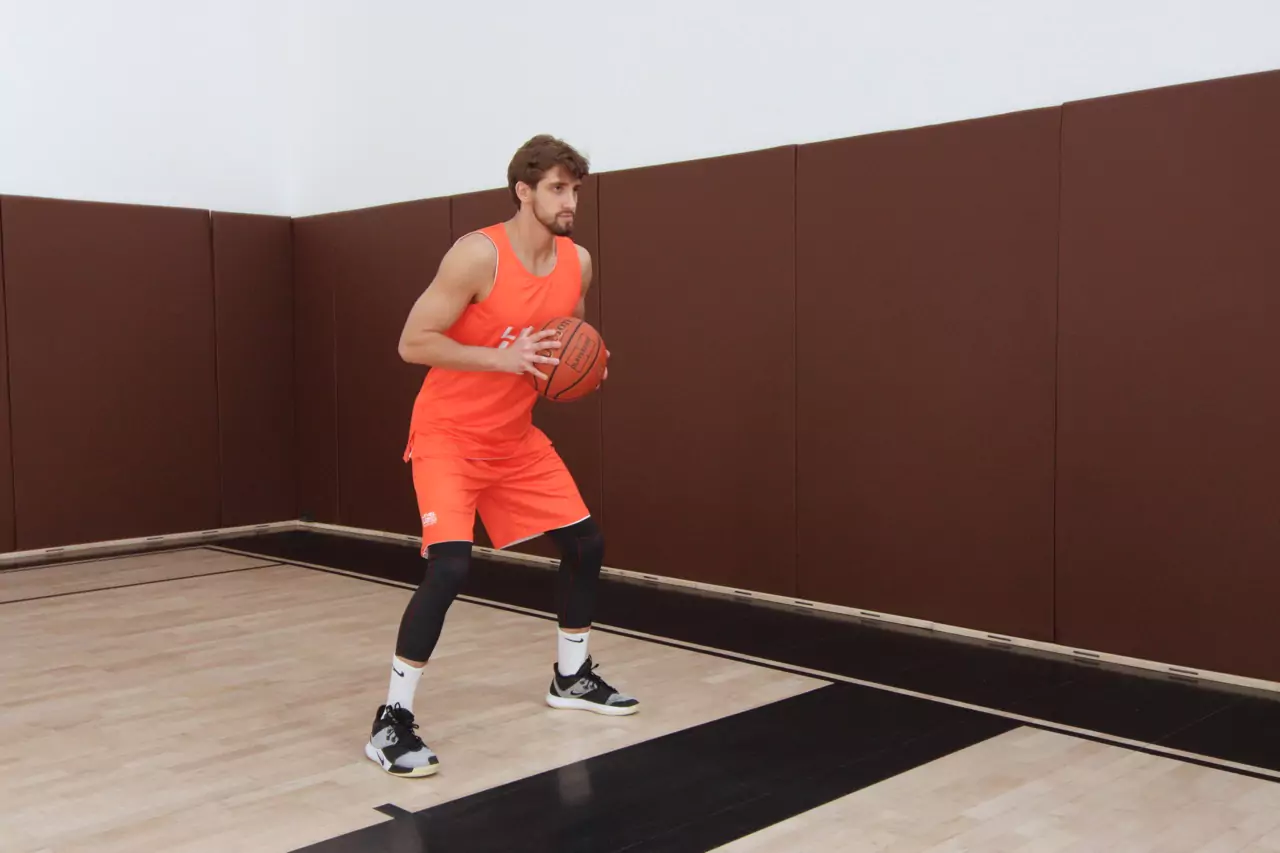
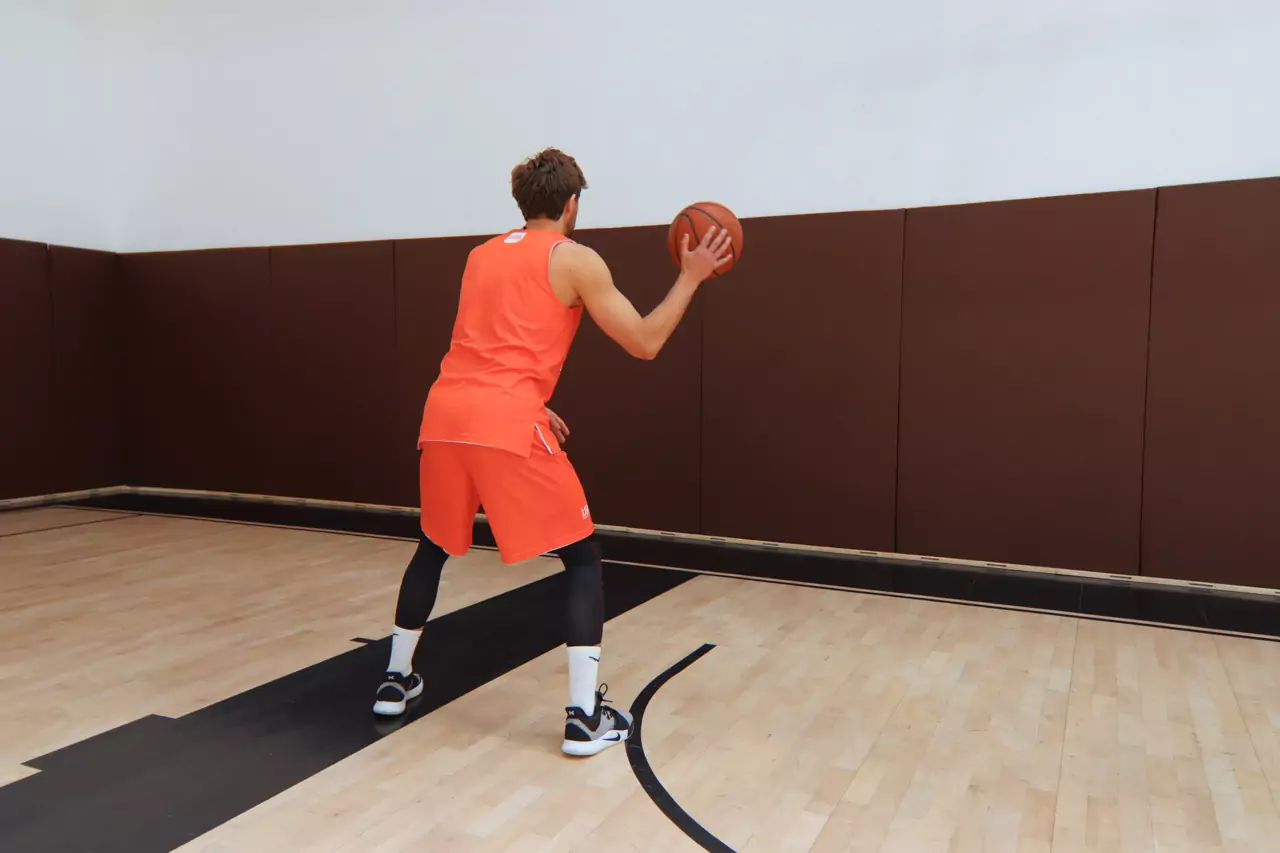
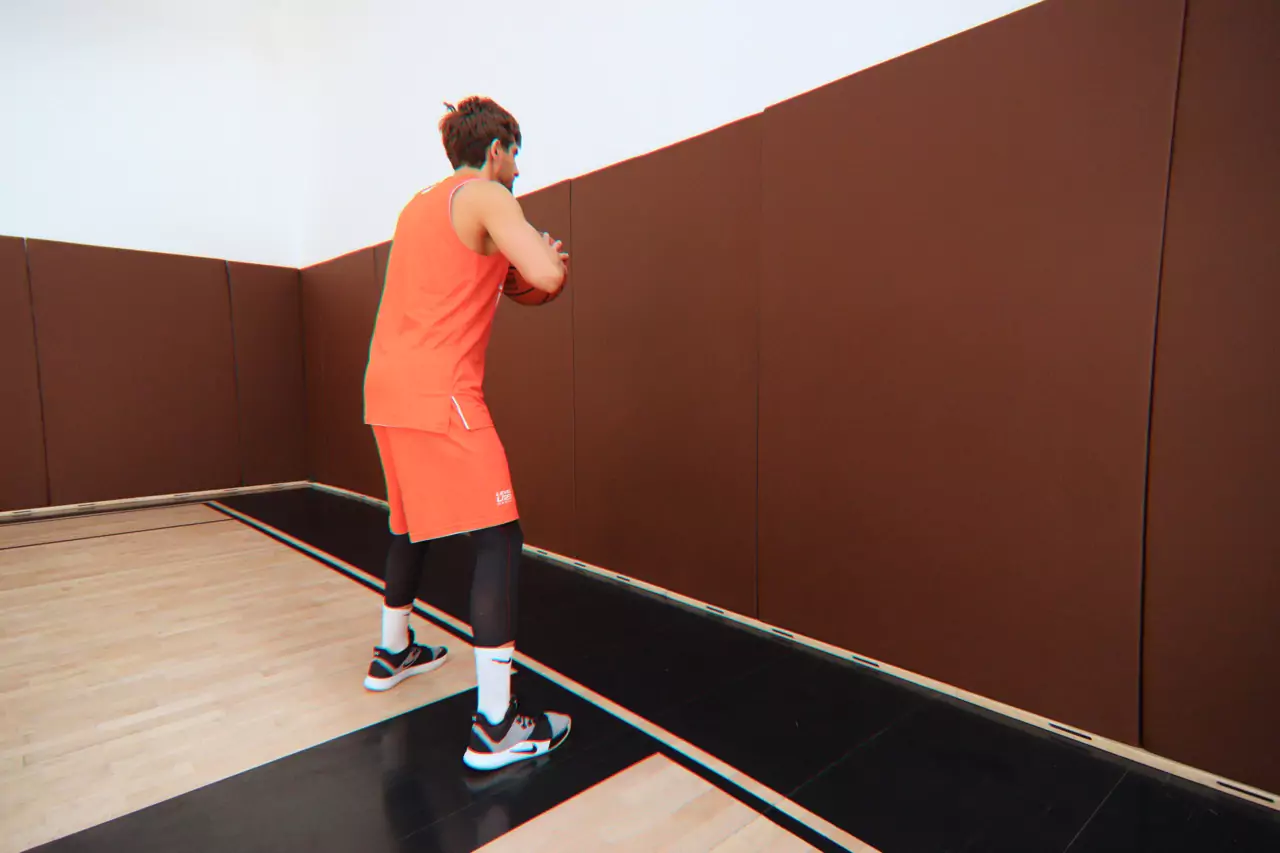
Players form pairs 10-12 feet apart in an athletic stance, ready to receive or deliver a pass. One player starts with the ball.
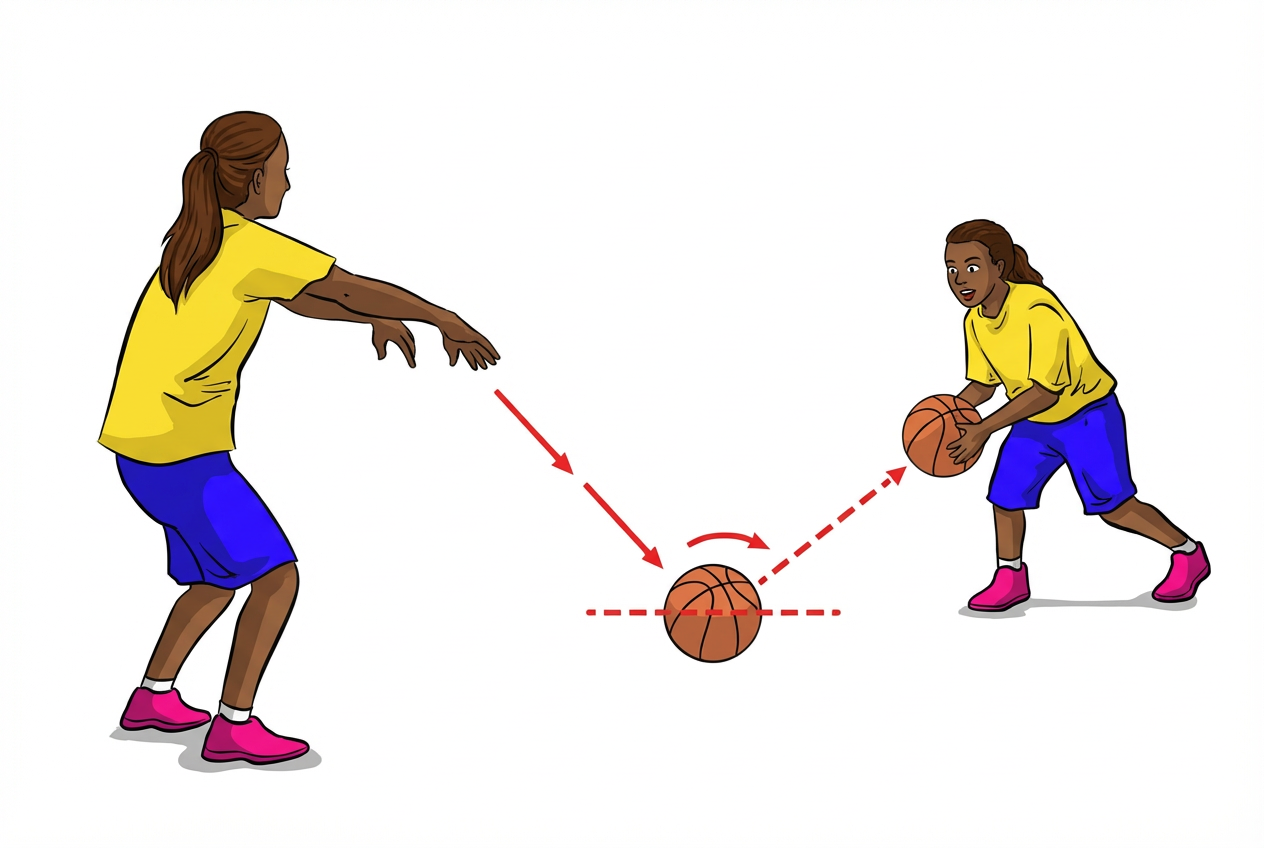
The player with the ball executes a two-handed bounce pass, aiming for the ball to bounce two-thirds of the way to the receiver, arriving at waist/chest level.
The receiver catches the ball, secures it, and immediately returns a two-handed bounce pass to their partner, maintaining the same bounce point and target.
After a set number of two-handed passes, players transition to passing exclusively with their dominant hand, initiating with two hands but releasing and following through with only the dominant hand.
Following dominant hand repetitions, players switch to passing exclusively with their non-dominant hand, emphasizing proper mechanics and a strong follow-through for a well-rounded game.
Players continue passing back and forth, rotating through two-handed, dominant, and non-dominant phases for a designated time or set number of successful passes, encouraging quick catch-and-release.
Required inventory:
Ball, Cones
Required skill level:
Advanced
Total reps:
Total time:
8
min
Rewards for this drill
Finish this drill and earn a reward! Get rewarded for brushing up on your skills in our mobile app today.
When defenders sag into passing lanes or when a post player has established deep position, a well-executed bounce pass can be the only way to deliver the ball cleanly and effectively. This advanced drill refines the fundamental bounce pass, transforming it from a basic skill into a precise weapon for navigating tight defensive pressure and creating scoring opportunities. Mastering this pass is crucial for guards feeding bigs, wings passing to cutters, or any player needing to thread the needle in congested areas of the court.
Slip Bounce Passes Under Sagging Defenders for Layups
The Advanced Bounce Pass Drill focuses on developing accuracy, touch, and proper mechanics for delivering passes that evade defenders and arrive precisely at the receiver's hands.
Players Needed: A minimum of two players are required to run this drill effectively. For optimal efficiency and competitive integration, groups of four to six players (two to three pairs) are recommended.
Equipment: One basketball per pair of players. Cones can be used for advanced variations to simulate defenders or define passing windows.
Court Setup: Players pair off and position themselves facing each other. Initially, they should stand approximately 10-12 feet apart, ideally along the free-throw line extended or the elbow area of the key. This distance can be adjusted based on player skill level and desired intensity.
How to Run the Drill
This drill emphasizes consistent, accurate bounce passing with a focus on both dominant and non-dominant hands.
Initial Setup: Players form pairs and stand facing each other, roughly 10-12 feet apart. One player in each pair starts with a basketball. Both players should adopt an athletic stance, knees bent, ready to receive or deliver a pass.
Two-Handed Bounce Pass: The player with the ball initiates the drill by executing a two-handed bounce pass to their partner. The ball should bounce approximately two-thirds of the way to the receiver, aiming for a soft, controlled bounce that arrives at the receiver's waist or chest level.
Receive and Return: The receiving player catches the ball, quickly secures it, and immediately returns a two-handed bounce pass to their partner, maintaining the same bounce point and target.
Dominant Hand Focus: After a set number of two-handed passes (e.g., 10-15 passes), players transition to passing exclusively with their dominant hand. The pass should still be initiated with two hands bringing the ball to the hip/side, but the release and follow-through are executed solely with the dominant hand.
Non-Dominant Hand Focus: Following the dominant hand repetitions, players switch to passing exclusively with their non-dominant hand. This is a critical phase for developing a well-rounded passing game. Emphasize proper mechanics and a strong follow-through, even if the pass is initially less accurate.
Continuous Repetitions: Players continue passing back and forth, rotating through two-handed, dominant hand, and non-dominant hand phases for a designated time (e.g., 2-3 minutes per phase) or a set number of successful passes (e.g., 20-30 passes per phase). Encourage quick catch-and-release to simulate game speed.
Coaching Points
Target the Bounce Point: For optimal trajectory and receiver comfort, the ball should ideally make contact with the floor approximately two-thirds of the way from the passer to the receiver. This ensures the ball bounces up to the receiver's waist or chest level, making it easy to catch and transition.
Power Step and Pronation: Encourage passers to take a power step forward with their non-passing foot as they release the ball. Simultaneously, the passing hand should pronate (turn over) through the release, with the thumb pointing down and pinky up, ensuring control and spin.
Full Follow-Through: The passing hand should follow through completely, extending towards the target with fingers pointed at the receiver. Imagine "shaking hands" with the target. This promotes accuracy and consistent power.
Athletic Stance and Vision: Players must maintain an athletic stance with knees bent and hips low throughout the drill. Before initiating the pass, players should briefly make eye contact with their receiver to ensure communication and readiness.
Emphasis on the Weak Hand: Dedicate significant time to developing the non-dominant hand. As a general guideline, players should aim to work their weak hand three times more than their strong hand during dedicated passing drills to achieve balance and versatility.
Common Mistakes
Incorrect Bounce Point: Players often bounce the ball too close to themselves or too far from the receiver, resulting in passes that are difficult to catch or that travel too slowly.
Fix: Coaches should visually mark the ideal bounce spot on the floor (e.g., with a piece of tape or a small cone) and instruct players to aim for that specific spot. Emphasize the "two-thirds rule" consistently.
Lack of Power and Follow-Through: Passes may be too soft, causing them to die before reaching the target, or inconsistent due to a truncated follow-through.
Fix: Remind players to step into the pass, use their core and legs for power, and fully extend their arm, snapping the wrist and pointing fingers at the target. Encourage a "punching" motion, but with control.
Standing Straight Up: Passing from a standing, upright position reduces leverage, power, and accuracy, making the pass easier for defenders to intercept.
Fix: Constantly cue players to maintain an athletic stance with bent knees and a slight forward lean. The power for the pass should originate from the lower body and core, not just the arms.
Progressions / Variations
Moving Targets: Instead of stationary partners, have receivers shuffle laterally along the baseline or free-throw line as they receive and return passes. This forces passers to lead their targets and adjust their bounce point.
"Fake and Pass" Integration: Introduce a defender (coach or passive player) positioned between the two passers. The passer must execute a pass fake (e.g., a chest pass fake or an overhead pass fake) to get the defender to commit, then quickly step around the imaginary defender and deliver a bounce pass. This teaches deception and passing angles.
Conditioning Bounce Passing: Incorporate movement and conditioning. After each successful bounce pass, the passer must perform a quick sprint to a cone and back, or a defensive slide for a short distance, before returning to receive the next pass. This adds a conditioning element and simulates game fatigue.
Advanced Defender Simulation: Place a cone or a coach holding a pad between the two passers. Players must deliver the bounce pass around or through a narrow window created by the obstacle, increasing the demand for precision and touch.